

What happens when your greatest achievements become barriers to your success?
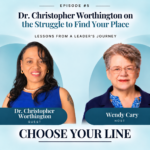
In this episode, Wendy Cary speaks with Dr. Christopher Worthington, an educator, criminal justice expert, mentor, and AI professional with seven academic degrees and 26 years of experience.
We explore the challenges of being perceived as overqualified, navigating hiring biases, building a stronger professional brand, and finding the right opportunities without hiding your accomplishments.
Christopher also shares her philosophy for overcoming setbacks: Retreat. Regroup. Retry.
A powerful conversation about resilience, reinvention, empathy, and never giving up.
Connect With Dr. Christopher Worthington
Linkedin: linkedin.com/in/worthingtonchristopher
Transcript
Wendy Cary
Welcome to Choose Your Line, where we look at the decisions that shape a career when pressure and ambition converge. I'm Wendy Cary.
Today, I'm talking with Dr. Christopher Worthington, an educator, consultant, mentor, tutor, and justice reform advocate. She taught criminal justice and public policy at Hampton University. She is an alumni of Sigma Gamma Rho Sorority Incorporated. She founded the nonprofit Worth a Second Chance to support reentry and educational equity and serves as a human rights commissioner. Most recently, she's brought that expertise into AI, evaluating and improving large language model outputs.
The situation we're exploring is one more and more people are facing in today's crowded job market, being seen as overqualified. With seven degrees and 26 years of experience, Christopher has watched doors close the moment someone sees PhD. We talk about the assumptions that title can trigger, how she tailors her resume to get past automated screening, how she prepares for interviews by focusing on what the organization needs, and what you can do when your experience is being read as a threat instead of an asset. One part of this conversation that especially stood out to me was Christopher's approach to rejection. Retreat, regroup, retry. A no isn't a verdict on your future, she says. It's a hiccup. And you can repeat the three Rs as many times as it takes.
Let's get into it.
So Christopher, welcome.
Dr. Christopher Worthington
Thank you. Thank you for the invitation. I'm glad to be here.
Wendy Cary
So to get us started, tell me a little bit more about what you're struggling with in terms of your brand.
Dr. Christopher Worthington
One of the issues I have is as a subject matter expert, educator, scholar, whatever way you want to phrase it, over qualification, I have 7 degrees, a PhD, 3 master's, 2 bachelor's, and an associate's, 26 years of professional experience in education, criminal justice, and AI. And so one of the issues that I tend to have is just being overqualified. And the moment people, a lot of people see PhD is an assumption made. And intimidation occurs in, you know, sometimes I miss out. I'm skipped simply because of the title.
Wendy Cary
Yeah, I think that a lot of people experience those kinds of struggles, feeling overqualified, especially in today's market, so many layoffs happening. The market is just inundated with a lot of people who are very qualified and looking for the right position, but unfortunately feel like they're overqualified in a lot of ways. So for you, how did that feel to you to realize that you were overqualified?
Dr. Christopher Worthington
It is disheartening. I worked really hard to get my education. It's always been a primary goal of mine. It's always been my objective. Even as a teenager, I had nothing else but education. And so it's really disheartening. It's difficult when you realize all that hard work you put into studying and learning. And you hear about society saying, education is a great thing to get. And the moment you receive it, it's shunned away. So yeah, it's disappointing.
Wendy Cary
And what do you think a lot of people misunderstand about what that's like for people who suddenly are in that position where people say you're overqualified?
Dr. Christopher Worthington
The first thing people think when they see PhD is, oh, she's a know-it-all. Oh, she thinks she knows everything. Oh, she might take my job. And that's when the door closes for me in my face. And so assumptions are often made that you know everything. And personally, I'm just smart in one particular area, but this evolved so much that, in some ways I'm still a novice. I don't know everything. I don't present myself to know everything. And it's just, it's really difficult. So, you know, I often have to resort to using different strategies to rebrand myself, to refine my goals, my objectives, my strategies, because they're trying the same way, it just fails.
Wendy Cary
That failure can really weigh heavily on people, that feeling of failure anyway. It's not that you're actually failing, but a lot of people believe that when they can't get hired because they're too much of something.
Dr. Christopher Worthington
Definitely.
Wendy Cary
What have you tried so far to overcome that?
Dr. Christopher Worthington
Oh boy, I have taken some of my degrees off my resume. I choose what degree is relevant, present that, so to speak, dummy down. Shouldn't have to, but Unfortunately, that's what it is. And then also another issue that I tend to face is, a lot of roles tend to be favor one gender over another. So fortunately, my name is Christopher. My first name is Christopher. So I leave off the miss or misses. Doctor is universal, so it could be either gender. But I've rebranded my resume. I change it. I customize it, take the job description, job responsibilities, quantify it, align it with my resume, and sometimes nine times out of 10, that's not even enough. So it's like looking for a needle in a haystack.
Wendy Cary
Yeah, You know, a lot of employers these days, don't just look at your resume. They go to LinkedIn and take a look at what's there. Have you done anything with your LinkedIn profile to change that to dumb it down, so to speak?
Dr. Christopher Worthington
To be, like you said, a lot of employers turn to LinkedIn. They even reach out via LinkedIn. And in fact, some jobs require you to apply through LinkedIn. So My LinkedIn profile, I keep that updated. I keep all of my job skills, accomplishments, everything on it. And that's like my professional story for me. The one part I dislike, because if you go to it, you can see the picture. And sometimes who you are can be that deciding force that whether you receive an interview, an invitation for an interview or not. And so it's, jobs don't require, don't turn to merit or credentials. They don't look at your qualifications anymore. They look at things of, well, you know, what's this person do they sell? Things that are totally unrelated to work. that's what they look at oftentimes. And so I keep LinkedIn. That's my story. So I figure if they're going to take the time to go and look at my LinkedIn, they're going to see the full picture.
Wendy Cary
Yeah, I love that, you're still giving people an avenue to see everything that you are. And meanwhile, your resume is tailored to make it through those AI bots that they have all that automation to sift through all of the resumes that they have. So you're at least getting through one step of that process. And hopefully your full story will hopefully intrigue people. Yeah. I mean, like I was intrigued. I loved looking at your LinkedIn profile and seeing how your diverse experiences and really wanted to get to know you. So I think that's so true and important that we make sure that we're presenting our full selves.
Dr. Christopher Worthington
Yes. It's definitely important because the old method of what we used to do, where you list everything on the resume, that's no longer feasible. And then when you have ATS, it filters out good candidates. Now it's more about words. And with AI, the most unqualified person can often beat the ATS system. And it's really, it's baffling because you have this person that have every, qualification that you require and they don't make it through the ATS. Meanwhile, this person that doesn't really have a clue what the job entails would get through it. So it's really, it's kind of, I wouldn't say a losing battle, but it's an uphill battle.
Wendy Cary
Right. Yeah. Absolutely. I hear that a lot for ageism that So many times people are being excluded because of their age. But yeah, I hear it a lot because of race, sexual orientation, all of that. So it's a really tough field right now. And I think, like you said, having your picture on your LinkedIn profile is sometimes a deterrent. And it's not the same level of privacy that we had 20, 30 years ago.
Dr. Christopher Worthington
Ageism is real. It's a big barrier that a lot of us have to face. And unfortunately, people with PhDs, they tend to be a little bit older than the person that just graduated from undergrad. So you're dealing with ageism, gender bias, sexual orientation bias, racial bias. And you know, in some instances, disability bias. And so you're dealing with a lot of things, and I fall into multiple categories. So again, for me, it's an uphill battle. It's really disheartening, disappointing. And, you know, it's difficult trying to say, okay, I'm not gonna give up. Well, if this doesn't work, I have this phrase I call retreat, regroup, retry. I say, I call it the three Rs because that's what I have to do oftentimes, you know, because I allow it to give me, it can, you know, it's, it make me feel defeated. And, you know, I know a lot of people can understand what that feels like. It's kind of heartbreaking, you know, and I've set many tears, many tears, even this year. I'm still facing those challenges. And but, you know, again, it's a rat race that I can't throw in the towel. So, you know, just keep trying different ways.
Wendy Cary
Yeah. And you're a mentor, a guide. You help people who are marginalized, who are poor or, you know, just having a difficult time in life. You help people and So I'm wondering, what do you advise them to do in cases like this?
Dr. Christopher Worthington
Well, I tell them, I'm sure you're familiar with the saying, it's more than one way to skin a cat. And for me, I'll be perfectly honest, as I shared with you earlier, I've been on my own since I was 16. And I didn't have anyone, no one. The only person that I had at that time had passed. And so I had to learn through trial and error, going through it. And I'm not one of those that I will see a person struggling and not offer a helping hand because had it not been for strangers that helped me many years ago, I wouldn't, I don't know where I would be at. So my thing is empathy. I understand what it feels like. I've been in their shoes and, paying it forward. That's my biggest goal. if anybody can benefit and receive encouragement from my story, what I went through, some of the things that I had to, survive, I don't mind sharing. And, people, especially in today's climate, people are challenged. People are facing some of the hardest situations they've ever had to deal with. And for a lot of people, it's kind of like a life and death thing. And so, we're all in this together. that's the way I kind of look at it. I'm gonna pull people with me. I'm gonna take people with me. I'm gonna push them forward because I figure what goes around comes around. I believe in karma. And so that's my philosophy.
Wendy Cary
Yeah, fantastic. So, you know, past that initial push to, you know, to apply to different jobs and making sure that your resume is gonna make it through. What about through the interview process? Is there anything that you do specifically to help make sure that they understand that you're there to do a job and your past doesn't necessarily overqualify you for what's going on right now?
Dr. Christopher Worthington
Yes, I'm glad you asked that because I just had an interview yesterday And it's a job I really want. And I study the job, study the skills, what I needed, what needs to be done in order to be considered successful. And I did my homework. I studied, I did my research. And so focusing on what I have done that aligns with what is required, focusing on those skills, you can't sit receive an invitation for an interview and then just like, okay, just walk in there willy-nilly and just swing it. You have to go prepare it because again, you don't know who the other candidates are. You don't know what their credentials are. You don't know what kind of bias that you're gonna deal with. And yesterday I went in there prepared and If I don't receive the job, I won't feel upset about it because I know I put my best foot forward and there was just somebody else who was better than me. But preparation, you take it seriously. Do your homework, do your research. Find out about the company that you're interviewing with because take that extra step, it matters. And yesterday I left that interview feeling confident, feeling like, okay, this might be the one. And so fingers crossed. But again, you have to do your research. You cannot just walk in there without any kind of preparation at all.
Wendy Cary
Yeah, that's so true. You really have to know about the company, about what they care about, and make that connection for them. of how you can fill their gap, how you can fit into their organization. So it's super important. And I love that you're focusing on how you fit rather than on all the great things that you've done, because you've done amazing things. Absolutely. But you're focusing on what will help this company, what's going on here and now?
Dr. Christopher Worthington
Yeah, definitely. You know, I don't people will look at me and say, oh, she's an overachiever. And if you start talking about too much of yourself, you sound arrogant, narcissistic, stuck up. And people don't want to, I wouldn't hire somebody like that. So, you know, if they don't ask, no point in me sharing. But like you said, I've done so much. I've, you know, form a magistrate, professor, correctional officer, educator, special education. It's so many things that I've done. No one wants to sit there and listen to me talk about myself all day. So yeah, they ask what's relevant to them and what they want. And that's what I typically share, how I can help them achieve their mission, whatever the goals may be. how I can help them go to the next level is what you can do for the job, for the company, not what the company can do for you.
Wendy Cary
I'm wondering, is there something important about preparing, interviewing, job searching when overqualified, potentially being viewed as overqualified for the roles you're looking for? Is there something important about that I haven't asked you yet?
Dr. Christopher Worthington
How I handle that, because oftentimes, again, the PhD, people automatically develop an assumption. Oh, she's overqualified. Oh, she's going to try to take my job. But my first approach is, I don't want your job. I don't know everything. And I don't care what a person's education level is. I can learn something from anybody because it's It's always something I don't know. And if you take that approach, hey, don't know everything. There's a lot that I don't know and you're willing to learn. And that's what I make sure that it's always known. I'm willing to learn. I want to learn. And a title is just that. It's a title. Doesn't mean that I know everything there is to know. So just being receptive to feedback. I love feedback. I don't like sugar-coated feedback. I don't wear my feelings on my shoulder, on my sleeves. And so telling me, giving me good criticism, honest criticism, honest feedback, that's very, very important. But making sure that they understand you're not coming in there to try to take over or do whatever it is they may have in mind.
Wendy Cary
Yeah, yeah. I agree, very important that you let them know that you're not a threat. You're here to do your job. You're interviewing for this position, not theirs, and that's on purpose. Yeah, yeah. Fantastic. Well, I'm wondering, what would you want listeners to take from your experience so far and what we've talked about?
Dr. Christopher Worthington
You have to keep trying. It's easy to feel defeated, to be discouraged, to feel like, you know, you're wasting your time and to give up. However, you know, what doesn't break you makes you. And you can't just give up. I mean, at this point, you know, keep in mind last year, you know, Thousands of people lost their jobs. So you got to look at the pool of challengers, so to speak, has increased. And don't take one no as a defeat. It doesn't determine your future. It's just a hiccup. But you got to keep pressing on. Don't give up. Don't surrender. And again, Retreat, regroup, retry, and repeat that as many times as necessary. And practice makes perfect, but we never achieve perfection. And when a person accepts that you're not going to be perfect, there's always something you can do better that helps.
Wendy Cary
I love the framing of it as a hiccup. Hiccups, they're annoying. They come without warning. Yes. And yet just they can be resolved fairly quickly. And then you're just going on. And what I don't even remember the last time I hiccuped, you know, it's such a little blip. So if you can frame these as a hiccup, then it's just something that happened in the past. It doesn't affect you going into the future. Hiccups don't hurt you or damage you in any way. So I love that framing. Perfect.
Dr. Christopher Worthington
Thank you. Yeah.
Wendy Cary
All right. So Christopher, thank you so much for being willing to talk about something you're working through right now, something you've struggled with over the years, and really appreciate the perspectives that you've shared and the chance to let the listeners know how you're approaching it in real time. It's so important to learn from those experiences. So from here, I'd love for listeners to be able to reach out to you if they're if they'd like. How can they learn more about you and your work?
Dr. Christopher Worthington
Well, my e-mail address is doctorcaworthington@gmail.com and doctor is spelled out D-O-C-T-O-R C A Worthington W-O-R-T-H-I-N-G-T-O-N. And then my LinkedIn profile, LinkedIn, Worthington, Christopher. And just reach out to me if you have, you know, want to bounce ideas, want to ask for, you know, advice or whatever, you know, I'm always willing to help.
Wendy Cary
Wonderful. Thank you so much. I'll make sure to include those links in the show notes.
Dr. Christopher Worthington
Thank you for having me. I greatly appreciate it.
Wendy Cary
Wonderful. Thanks for listening to Choose Your Line. You can find more information about Dr. Christopher Worthington along with the resources we mentioned in the show notes.
And if this conversation gave you something to think about, follow Choose Your Line so you don't miss the next episode. And if you know someone who would benefit from this conversation, send it their way.
Until next time, pay attention to the choices in front of you, trust your judgment, and choose your line.