
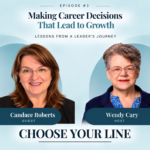

In this episode of Choose Your Line, host Wendy Cary sits down with Candace Roberts, founder of Thought Trails and an experienced data strategy and transformation executive, to explore the career decisions that shape professional growth.
Candace shares how choosing to stay in an unexpected role led to the greatest career growth of her life.
They discuss navigating organizational changes, recognizing the difference between a promising pitch and a supported plan, and embracing uncertainty.
Candace also shares leadership lessons on building trust, empowering teams, simplifying complex systems, and adapting to change.
Discover why stepping outside your comfort zone can unlock new opportunities and why the safest choice isn't always the best one.
Tune in for practical insights on career growth, leadership, and making bold decisions with confidence.
Transcript
Wendy Cary
Welcome to Choose Your Line, where we look at the decisions that shape a career when pressure and ambition converge. I'm Wendy Cary. Today I'm joined by Candace Roberts, founder of Thought Trails and Data Strategy Transformation Executive. With more than 25 years of experience in data analytics and leadership, She helps organizations turn complex information into decisions people can trust and use. We talk about deciding whether to stay or leave when a new role isn't what you expected, including how to distinguish a promising pitch from a plan that the organization will actually support, how repeated reorganizations taught Candace to adapt, and what leaders can do when neither option comes with a guarantee. One part of this conversation that especially stood out to me was that staying can sometimes be the bolder choice. Candace turned down a strong offer to trust a new leader's plan, and that decision led to the greatest career growth she had experienced. Let's get into it. Candace, welcome. I'm so glad you're here.
Candace Roberts
Thank you for inviting me, Wendy.
Wendy Cary
Yeah, to get us started, let's start talking about that scenario you were in. What happened?
Candace Roberts
Yeah, early in my career, I was in a role that I didn't accept to have. This is back when I was an analyst. So I wasn't quite until leadership yet at this point. I was an analyst, but I was in a role that started and it wasn't quite what I signed up for, it seems like. So at that stage, There was a lot going on within the organization. And actually, within a couple of months of me starting this role, there was a reorg that happened, which makes you a little nervous as well. So I was expecting to leave. So I was actively interviewing. I actually had a great offer sitting on the table. And then a new leader who would become my boss came in with an actual plan on how he was going to transform our business intelligence team. It wasn't an elevator pitch. It was actually a plan. So I had to roll the dice to decide, do I stay or do I go? And I opted to stay. I chose the path less traveled, which is the one that's a little bit more scary. So I did choose that path. And what resulted was that we did build a beautiful team. We did manage to execute the plan. And I had the largest career growth that I ever had working at this company. And I'm so glad that I rolled the dice and stayed. I could have taken a safer path, but in this case, it worked out.
Wendy Cary
Yeah, that's amazing because so many people are afraid of that. Things are not right when you get in. And how can you trust that this one person is going to change how things are happening within the company, what's happening within the company? So you said he came in with a plan. And one thing that I think people get concerned about is that plan vetted and accepted by the executive leadership team.
Candace Roberts
Yeah, and I think that's an important note to do this. So that was one of the key points of this plan is it wasn't just arbitrary. It wasn't just something it obviously was dreamed up and we want to execute this. However, it was part of when he came in to the door, it was already approved. It was part of him starting. It was part of the agreement with them. So at the end of the day, it had already been vetted. Senior leadership was on board. They were ready to send the money on the software or the tools or whatever it was that was going to happen. So that's why I say there was a plan and not just a pitch. It was already vetted. And I was like, okay, somebody else is behind you on this because I trusted my career to someone at that point. who I just met, but gave me great confidence because of how it was presented.
Wendy Cary
So I'm sure you were nervous as you considered that and thought about this other job that you had lined up. How did you handle that, pulling you back and forth in between those two decisions?
Candace Roberts
There was a lot of anxiety over it. There really was. So in my particular case, I'm the provider in my home. So That I really had to weigh that fairly heavily as to what I wanted to do. But at the end of the day, I thought about, I was like, I could move to another role and that could pan out to not be what I was expecting either. So I weighed it that way. So dealing with weighing both sides and seeing the pros and the cons and seeing where do I want to take my chance is I think where it boiled down to. And. I opted to take my chance with something that I knew was already vetted. That made me feel a little bit better about my choice. Obviously, the hardest part is that when you work under companies who like to do reorgs very often, which is in my case, the industry that I was in, it was just normal for that to happen. It makes you wonder just, did I make the right choice? Is it longevity in this role? But at the end of the day, I learned so much from this new leader that it really helped me to make my career blossom at the end of the day.
Wendy Cary
Yeah. I'm curious, you said in that industry there were a lot of reorgs. And did you know that about this industry before that new boss talked to you about their plan?
Candace Roberts
I did not. I did not realize it. So it was a whole new adventure for me for many years as I went through it. And it just became part of the cycle of life, so to speak, within working within this organization. Things change. You get new CEOs, you get new senior leaders, you get new people in general. Some through attrition and some through hire. It just depends on what's going on and teams change. And so what this did for me is it really helped me to navigate a whole new world And I learned how to handle change way better and how to be very flexible and especially when you're in the data strategy end of the world, how to be really flexible and moving back and forth as different decisions are being made and how you would take what you've had and apply it to the new and vice versa, take the new, apply it to the old and whatnot. So it really gave me a lot of growth in how to work through an organizational structure that is not always easy. I'm very grateful for that. I know it sounds strange, but I am very grateful to have those learning experiences.
Wendy Cary
A lot of people are afraid of change, but it sounds like you welcome it. And that change is where some real growth can happen. You're getting used to new people and then leaving them and meeting other people and working closely with them. And you get to experience a wide variety of people and environments and teams and ways of working, and it can really build your career pretty quickly.
Candace Roberts
Yeah, it absolutely can. So I don't know who said it, but there was a quote once that said, the only thing that doesn't change is change itself. So change is the only thing that is always going to happen. So you have to roll with the punches as you're going through it, right? You can't just expect everything to stay stagnant. Think of the way the world is today, like with the rise of AI, for example. The way that we work is changing so fast and we have to adapt.
Wendy Cary
Yeah, we do. It's so important these days. I'm curious because you didn't know about the reorgs before this new boss came in. So that wasn't really part of your decision. Did you end up moving away from that boss during reorgs or were you somehow able to still work with that person?
Candace Roberts
No, I was able to stay with him for the entire time until he moved on to his next adventure.
Wendy Cary
Wow, that's so exciting. That's unusual, especially with some place that does so many reorgs.
Candace Roberts
And to be fair, we built something really great and completely changed the way that the organization worked, moved them from all these scattered spreadsheets and reporting platforms to something more centralized. And to helping the organization move to being truly data-driven as opposed to making decisions off the cuff.
Wendy Cary
Yeah, exactly. And that change in an organization can be very slow or it can be accelerated by a plan like this. But there's this, at least to me and some of my clients in the past, there's this excitement about making some really meaningful impact through that. And while it's really slow and you don't get these huge accolades for being an awesome employee, you're a little bit more, not quite as visible. And yet you are maturing the organization.
Candace Roberts
That is correct. And it's so true. Nobody's going to toot your horn for you. have to do it yourself, so to speak. And I know as a leader, I always sung my team's praises. So Whether it be in a leadership meeting or like all hands type of a meeting or whatever, I always tried to make sure that they were visible, that we were visible as a team. Hey, we're doing these great things and let's talk about it. Let's make sure that people see what's going on. You're not just giving pretty new dashboards, for example. There's a lot of hard work that goes in under the hood to get that to work. So singing people's praises, especially when a lot of it, it's like an iceberg. They only see the tip, but there's so much underneath that has to happen for it to get there.
Wendy Cary
Yeah, so much underneath. You're so right. So you mentioned before we started the call today, you mentioned that you have some new choices similar to that first experience. with choosing between one job and another. And you said you're going through that again. Tell us more about that.
Candace Roberts
Yeah, so I am going through this again. I am looking for my next adventure, seeing where I'm going to land. I'm not quite sure what it all looks like yet. I'm in the planning stages right now for the most part, just talking to lots of people, going to different networking events, seeing where things are going to actually land to where I want them to be. that sort of thing. And so I'm getting there. And it's a little bit scary to be out on that ledge, just so But at the end of the day, it's exciting at the same time. It's, you don't know what's around the next corner. You don't know what opportunity is going to be there. We talked a little bit about this, but I am a true believer in that when opportunity knocks at your door, you invite the man for dinner and drinks. See what they have to say, right? And engage it. Don't shy from it. Actually engage in what it is that's coming down your path. And even if you take a left, doesn't mean that you can't circle back and come back and take a right later on if you have to. But being a little adventurous and seeing and exploring what's out there, I think is a really hard part for people. It can be really difficult. There's been plenty of these forks in the road in my career path over the years. Even if I was to go way, way back before I got into tech, I ran restaurants. And so I made a conscious decision to not be in restaurants anymore. And I wanted to find something different. And it led me down to the state of strategy path that I'm in. So you just never know where things are going to land.
Wendy Cary
Yeah, you never know. Wow, that's amazing. I love that when opportunity knocks invited in for dinner and drinks. And that's so true. But like you said, a lot of people have a hard time with that. And I think One of the things behind that is that feeling like when you make a choice, you can't change, that it's permanent. And so that creates a lot of fear around taking these opportunities.
Candace Roberts
It does, but the only way to grow is to step outside of your comfort zone. For me, it has served me very well to step outside of the box. One of my dear friends has always told me, like, Candace, Here's the box. You are never quite in the box. You're like around the box, on the box, peeking into the box. But I'm always just trying to see the best way for me to get things done for me personally and how that applies to the situation that I'm in. So being able to think a little bit differently and taking those challenges on, I think could help whoever is trying to do that. If you keep locking yourself in that box, you're not going to grow. You have to at least step outside long enough to take a breath and see what else is there.
Wendy Cary
Yeah, take a breath and get perspective. If you're inside the box, you just see it from one point of view. If you're inside the box, peeking in, looking around it, you get a lot more perspective that way. I love that analogy.
Candace Roberts
You do. And there was a project that I worked on actually where I did this with my team recently. And We basically took something that had over 300 dashboards and was able to cut it down by 90% and ended up with 30 because we took a different approach. And the approach was, what does the business actually need to run? What metrics do they need? What groupings or dimensions do they need? What do they actually need? Do we really need all this? And we were able to streamline it and it was so much cleaner. People can find what they were looking for. Things ran very smooth. And we did it with zero parallel cutover and it worked out great. If my team ever hears this, kudos team for helping getting that done. So they did an awesome job and I was very fortunate to lead that effort and I rolled up my sleeves and dug in as well during that time. But things like that is you don't have to stay with the status quo. Just because it's always been done that way doesn't mean it has to continue to be that way. You can always look for new alternatives and still get the answers you need to run your business. No matter how big it is. It could be a solopreneur business or it could be a large corporation. There are ways to streamline or look at it differently and just because it's always been doesn't mean it has to always be.
Wendy Cary
And I would add that's true for higher education, government, those places that have a lot of red tape and very little change. Those things are still possible in those environments. Maybe it'll go a little slower. There's some red tape you got to take care of, but change is possible everywhere.
Candace Roberts
And I'm not saying to violate policies. Let's not do that. We want red tape exist in a lot of places, even in small companies. You can see some of that. But within the parameters of which your organization is, like right now with the rise of AI, companies really are changing the way that they have to operate and how business is being done. And I read an article somewhere, I cannot remember where it was, but that says 90% of AI pilots are failing. That may be because we're just not prepared for it. The data's not ready, the plan's not ready, we're taking on more than we can chew. start with something small, see if it works and then move it forward. Eventually, all these things will link together. So businesses have to, who are to keep up with the times, are going to have to navigate new technology, new ways of doing things, running on streamlined teams, all those different things come into play, especially in today's world.
Wendy Cary
Yeah, it really does. So I'm wondering, I want to make sure that leaders who are listening to this episode, that they have something to take away from it, what would you want those leaders to take from your experience?
Candace Roberts
So I think that leaders need to look at where they are, where they could be, and how can they get there. So I think that planning is important in general. For me personally, every time I've taken on a project, there's a couple things I always embed in my project plan. One is documentation. Please make sure you document what you're doing so that people can follow it after the fact. That's one. The next is I always like to do a, people like to call it a post-mortem, but I'm not really a fan of that term. But when the project's over, what could you have done better? Because that'll make the next one better. And then making sure that your team is involved. If all the decisions come from you as a leader, that's not involving your team. And the team needs to have a say in this. has always worked really well for me personally. I've run a really lean team. And when they have a say and a stake in the game, you find that they perform way better and things get done way faster. And at the end of the day, that's what we're all about, is trying to make sure that we can get things done Make sure we're supporting the business. Make sure the business is operating. And in order to do that, we have to be flexible. I've worked with leaders in the past. They just did not involve the team. It was like they made every decision and we're micromanaging. Trust them. They're professionals. They can help you. I learn from them as much as they learn from me. They have ideas and they have great feedback. I've never had a team that didn't have that kind of, where I had that relationship where it didn't come out like that. So if I was going to give any advice to any leader, I would say you have to roll with change, involve your team, and be humble enough to know that you're not the only one without the answers.
Wendy Cary
Oh, wonderful. Thank you so much. Thank you for being willing to talk about something that you're currently working through and really appreciate the perspective that you shared. In fact, the perspective of considering multiple perspectives. So I'm wondering where can leaders learn more about you and your work?
Candace Roberts
So the easiest place to find me right now is on LinkedIn. So you can find me under Candace, P as in Peter, Roberts. That's the easiest place to find me. Wendy, I'm happy with Wendy, you already have it. Feel free to share my LinkedIn link with your podcast folks, but that's the easiest place to find me today.
Wendy Cary
Yeah, great. I'll definitely include that link in the show notes. Thank you so much for joining me and sharing your perspective.
Candace Roberts
Great. Thank you so much. I'm always happy to talk shop.
Wendy Cary
Thanks for listening to Choose Your Line. You can find more information about Candace Roberts along with the resources we mentioned in the show notes.
If this conversation gave you something to think about, follow Choose Your Line so you don't miss the next episode. And if you know someone who would benefit from this conversation, send it their way. Until next time, pay attention to the choices in front of you, trust your judgment, and choose your line.